English is not my first language. Even so, I chose to run an international business. I still think that my English sucks, so I use AI to work on it every day.
Doing this, I learned that the dangerous output is rarely the obviously bad one. It is when the output comes too clean that I need to pay more attention.
The argument is still there. The grammar is correct. Every sentence flows. But when I read it, I can't stop thinking: "I would never say this."
AI can make a founder sound more fluent in English while making the founder less recognizable. It removes repetitions, repairs strange expressions, replaces local references, organizes every paragraph and gives the text the same professional rhythm it gives everyone else. Suddenly, you lose your accent, your arguments and your truth.
But you receive better English in the package of a weaker signal of who is speaking.
For a founder, that exchange can be expensive. Your authority does not come only from correct information. It also comes from the details you notice, the comparisons you make, the words you refuse to use, the jokes that need a little context and the way you admit uncertainty.
Translation has to carry those things too. Because when you speak in public, the distance will catch up with you. You are not that polished IRL.
Can AI translate your writing without losing your voice?
Yes, but the model needs more than the text and a request to translate it. It needs the full context. And this is where many people lose time and end up giving up on spreading their words.
A voice-preserving translation needs three kinds of context:
- what the text means;
- how the author creates that meaning;
- which imperfections, tensions and cultural signals are intentional.
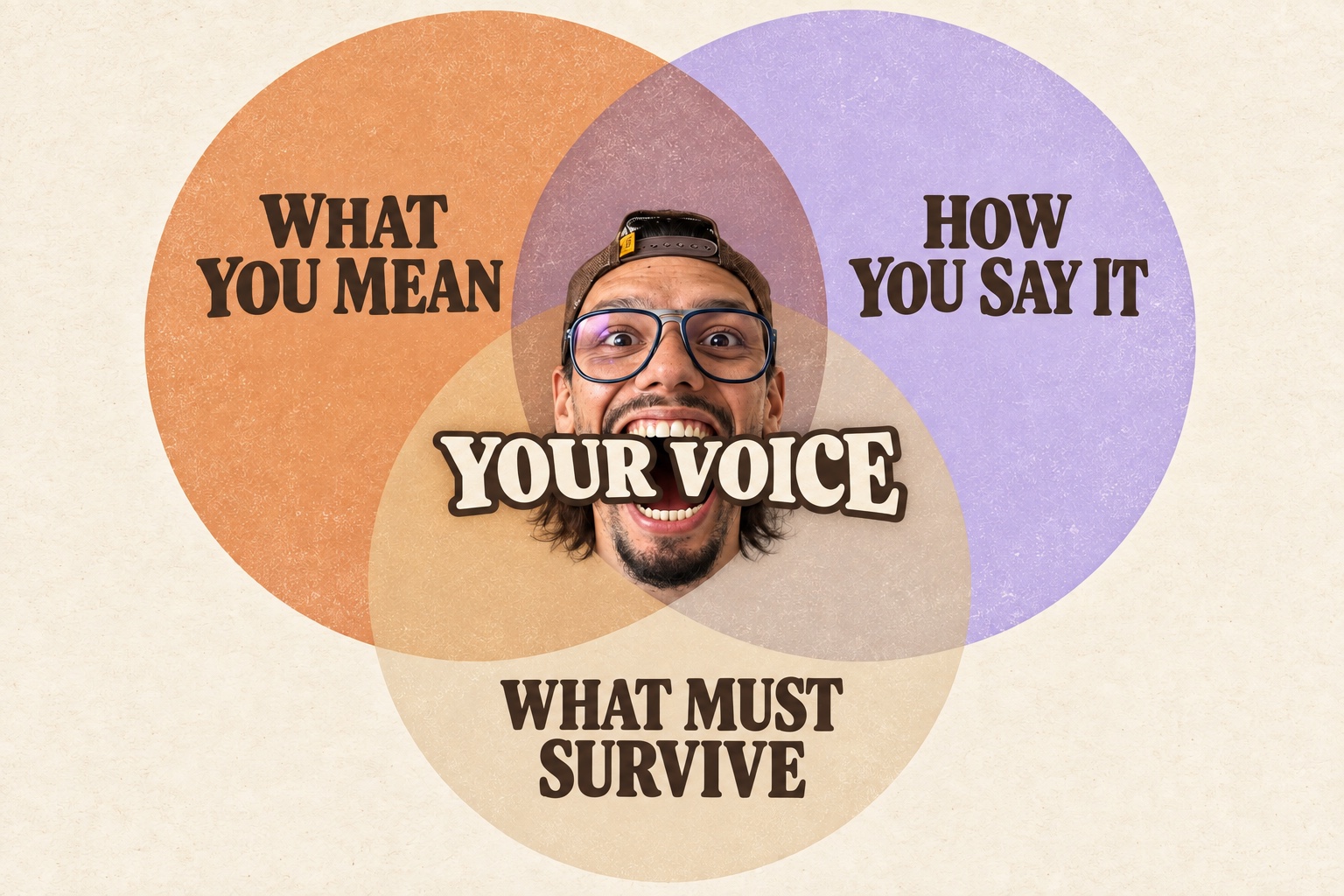
Most one-line translation prompts provide only the first.
“Translate this into natural English” sounds reasonable. The word natural gives the model permission to move toward common English patterns. “Make it sound native” goes further. It asks the model to replace the source language's rhythm with an imagined native standard.
Native English is not a voice. It is a very large group of voices. When the prompt gives no evidence of yours, the model has to choose a probable one.
That is how a Brazilian founder, a Finnish researcher and an Indian product leader can come back sounding like the same person from the internet.
Why does AI translation flatten writing?
Language models are good at producing probable language. Distinctive writing often lives in less probable choices.
Language matters. That's why what you say needs to be chosen by you, not randomly chosen by a machine.
A repeated word can show insistence. A sentence that runs longer than expected can reproduce how someone discovers an idea while speaking. An unusual comparison can carry a place, a family or a period of the author's life. Slightly imperfect English can show where the person is coming from without making the text difficult to understand.
A generic translation request treats many of those signals as noise.
Research is beginning to document the effect. A 2025 preprint based on four studies associated the use of large language models as writing assistants with a decline in linguistic diversity. Another study found that AI suggestions moved writing toward Western styles and reduced cultural nuance. A 2026 preprint focused on second-language writing describes a related problem as pragmatic flattening: text becomes more correct while some of the author's rhetorical agency and sociocultural meaning disappear.
These studies do not prove that every AI-assisted translation becomes generic. They make the default worth questioning. Fluency and fidelity are different things.
What parts of your voice should a translation preserve?
Tone is only one layer. Asking the AI to keep the text “friendly” or “confident” leaves most of the author's choices undefined.
A useful voice brief looks for evidence in at least six areas.
1. Position
Where does the author stand in relation to the subject?
Someone who lived through an event writes differently from someone summarizing it. Preserve phrases such as “I remember,” “I was in the room,” “I do not know” and “this is what I saw.” They show the limits and source of the author's authority.
2. Rhythm
Notice sentence length, repetition, pauses, fragments and the order in which the idea is discovered.
If every translated sentence becomes medium-length and perfectly connected, the information may survive while the person disappears.
3. Register
Formality carries intention. Translation research has treated formality as information that should be controlled, rather than a cosmetic layer added after literal meaning.
Decide whether the author is speaking to a friend, a customer, a conference audience or an investor. Do not let the tool choose that relationship by default.
4. Specificity
Protect names, scenes, objects, quotes and behaviors.
AI often replaces a strange concrete detail with a smooth abstraction. “The logo looked like a sperm on an orange” may become “the early branding was still evolving.” The second sentence is safer. It has also removed the person who noticed the first one.
5. Cultural references and humor
Some references should be translated. Some need one line of context. Some should remain in the original language.
The model can propose the options. The author has to decide which loss is acceptable.
6. Productive imperfection
Keep the difference between incorrect English and non-standard English visible.
An error that blocks comprehension should be fixed. A slightly unusual construction that carries rhythm or identity may be worth keeping. Perfect grammar is one criterion. It is not the only criterion.
What does voice loss look like in an AI translation?
Here is one line from a voice note I recorded in Portuguese while telling the early story of Exact Sales:
That recording later became our field note about what happens when a company outgrows its story.
Eu vivi toda essa época que ele passou. Eu vi todos os concorrentes nascerem e ficarem pra trás enquanto a Exact crescia.
A fluent translation could read:
I witnessed this entire period and observed competitors emerge and fall behind as Exact Sales grew.
The information is accurate. The distance from the speaker has changed. Witnessed, observed and emerge create a more formal narrator than the person in the recording. The repetition of eu vivi and eu vi disappeared, even though that repetition established why I had the right to tell the story.
A version closer to my voice would be:
I lived the years he is describing. I saw every competitor being born, and I saw them falling behind while Exact kept growing.
This version is less compressed. It repeats I saw. That is part of the evidence, not an editing accident.
The best translation will not always stay this close to the source. The useful question is whether each departure helps the reader understand the same person or quietly replaces them.
A practical workflow for voice-preserving AI translation
The safest workflow separates interpretation, translation and approval. Asking for all three in one step makes changes harder to see.
Step 1: Write before the AI writes
Start in the language where the thought has the most detail.
Use a voice note if speaking gives you more energy than typing. Keep the side comments, corrections, jokes and examples. They are evidence of how you think, even when they do not all survive the final edit.
Giving the model bullet points and asking it to create the finished English text transfers authorship much earlier. Giving it a real draft creates something it can translate and something you can compare.
Step 2: Ask for a voice diagnosis before translation
Have the model identify voice markers using quotes from the source.
Do not accept labels such as “warm,” “bold” or “conversational” without evidence. Ask which words, sentence patterns, repetitions and rhetorical moves created that impression.
This step exposes misunderstandings before they enter every paragraph.
Step 3: Define what can and cannot change
Create three short lists:
- Preserve: position, examples, humor, rhythm, repeated words, uncertainty and intentional friction.
- Adapt: idioms, references that need context, sentence order when English comprehension requires it.
- Flag: anything with no clean equivalent, any new claim and any change in strength, certainty or emotional tone.
The flag list matters. A model that must always return a finished answer will often hide ambiguity inside a confident sentence.
Step 4: Request more than one translation
Ask for:
- a close translation that stays near the structure of the source;
- a voice-preserving English version that can change structure when necessary;
- a short explanation of the meaningful differences.
The close version is not meant for publication. It gives you a reference point. The second version shows the editorial choices. The explanation lets you inspect them.
Step 5: Review for voice loss, not only translation errors
Traditional review asks whether the meaning is correct. Add another pass:
- Which concrete details became abstractions?
- Which repetitions disappeared?
- Did uncertainty become certainty?
- Did humor become professionalism?
- Did the author become more promotional?
- Could this paragraph now belong to almost any founder?
Back-translation can reveal missing meaning. It is less reliable for identifying lost rhythm, status, humor or cultural position. Compare the two texts as expressions of a person, not only as containers of facts.
Step 6: Let the author make the final English imperfect
The final pass belongs to the person whose name will appear on the text.
Read it aloud. Replace the words you would never use. Put back the detail the model considered unnecessary. Break the sentence that became too elegant. Reject the idiom you understand but would never say.
The goal is clear English that still points back to the same person.
A prompt for translating with AI while preserving voice
Use this as a starting point and replace the generic instructions with evidence from your own writing.
Translate the text below from [source language] into clear international English for [audience and situation].
Before translating, identify five characteristics of the author's voice. Support each characteristic with a short quote from the source. Also identify idioms, jokes, cultural references and phrases that have no exact English equivalent.
Preserve the author's first-person position, degree of certainty, concrete examples, humor, repetitions and sentence rhythm whenever comprehension allows. Do not add claims, motivational language, marketing clichés or idioms the author did not use. Do not make the author sound more promotional, certain or native.
Produce:
- a close translation;
- a voice-preserving version for publication;
- a change log explaining where you changed structure, register, humor or cultural references;
- a list of decisions that require the author's approval.
Here are three samples of the author's approved English writing: [paste samples].
Here is the source text: [paste source].
Examples matter more than adjectives. Three pieces of approved writing give the model stronger evidence than telling it to sound “authentic.”
Should a non-native founder try to sound native in English?
Aim to be understood by the people you want to reach. Native imitation is a different goal.
Your English can be clear, credible and intentional while still carrying evidence of another language. The decision depends on context. A legal agreement has little room for productive ambiguity. A founder story, keynote, essay or point-of-view article has much more to lose when every unusual choice is normalized.
AI can be an equalizer here. It can expose ambiguity, propose alternatives, explain register and help a founder reach readers without waiting for a perfect command of English.
The same tool can also become a gatekeeper that replaces one person's English with a standardized version of authority.
The difference is in the workflow and in who has the final word.
How do you know whether the translated text still sounds like you?
Do not ask only, “Is the English good?”
Ask:
- Would I say this aloud?
- Is my level of certainty still accurate?
- Are the details only I would notice still present?
- Did the translation preserve how I relate to the reader?
- Can I explain why each significant change was made?
- Does this sound like my English, or like English rented from the tool?
If the text is easier to read and harder to recognize, the translation solved only half of the problem.
From translation prompt to founder voice system
A prompt can protect one text. A voice system protects the decisions across many texts.
That system needs approved examples, recurring phrases, prohibited patterns, corrections, stories, cultural references and a record of what the author accepted or rejected. It should learn that one person likes fragments, another uses long exploratory sentences, and another never makes a claim without showing where it came from.
The source of truth cannot live only in the model's memory. It has to remain inspectable by the author and the people working with them.
This is how we think about founder voice inside Narrative OS. AI can help retrieve, compare, translate and generate alternatives. A human still decides which version carries the same person into the new language.
Speed comes from the machine. Authority stays with the author.
Frequently asked questions
Can ChatGPT translate while keeping the original tone?
It can preserve tone more reliably when you provide the audience, context, approved writing samples and explicit instructions about what must survive. Ask it to identify voice markers first and to explain meaningful changes after translating.
Why does AI-translated writing sound generic?
Generic output usually appears when the model has the source text but no evidence of the author's style, audience or intent. It moves toward probable, fluent language and silently normalizes unusual choices.
What is the best AI translation prompt for preserving voice?
The best prompt describes the task, audience, source and target language; includes approved samples; separates what to preserve, adapt and flag; requests multiple versions; and requires a change log. The template above provides that structure.
Should AI correct all grammar mistakes made by a non-native writer?
Correct errors that block comprehension or change the intended meaning. Review unusual but understandable constructions individually. Some carry rhythm, identity or emphasis that a complete correction would remove.
Is brand voice the same as founder voice?
Founder voice belongs to a person and includes lived experience, habits, uncertainty and individual perspective. Brand voice is a shared system designed for consistent use by more people. A founder-led company may begin with significant overlap, but the two should become explicit as the company grows.
Source note
- The Shrinking Landscape of Linguistic Diversity in the Age of Large Language Models, 2025 preprint.
- AI Suggestions Homogenize Writing Toward Western Styles and Diminish Cultural Nuances, 2024 preprint.
- The Cost of Perfect English: Pragmatic Flattening and the Erasure of Authorial Voice in L2 Writing Supported by GenAI, 2026 preprint.
- A Study of Style in Machine Translation: Controlling the Formality of Machine Translation Output, EMNLP 2017.
- Writing with ChatGPT, OpenAI Academy, 2026.
- Style rules for smarter translation and writing, DeepL.