You have seen this happen. A startup starts creating more versions of the business than the founder can personally reconcile.
Sales, Marketing, Product, employees, and customers begin using different explanations for the same solution.
The founder becomes the person who keeps correcting those explanations, usually one conversation at a time.
This gap can stay invisible while the website, deck, and tagline still look coherent. Then someone has to decide which customer fits, how to explain a new product, or why the company is entering a new market. The answers start to separate.
We call this narrative drift.
What does it mean for a company to outgrow its story?
It usually means that the explanation that helped the company begin can no longer hold everything the business has become.
New products, people, customers, markets, and decisions add meaning to the company. If that meaning stays inside the founder's head, each team fills the missing parts with its own version.
Early in a founder-led company, proximity keeps the story together. The founder joins sales calls, hires the first employees, explains product decisions, and repeats the origin story until people absorb it.
Growth creates a gap when it changes that proximity:
- New employees learn from supervisors who learned from managers.
- Customers describe value in language the company never planned.
- Sales adapts the pitch to win a difficult deal.
- Product changes the promise through what it builds.
Each adaptation can make sense on its own. The problem appears when those adaptations stop belonging to the same whole.
What happened when a company outgrew its first story?
I watched it happen when a commercial method became a product, a company, and a category that more people could explain. The better the idea traveled, the less it belonged only to the people who created it.
Let me explain what I mean.
I joined Exact Sales, a Brazilian startup, as employee number 19. We were still selling the MVP as a spreadsheet. The software was starting to be born, the logo was supposed to be an “e” but looked more like a sperm on an orange, and the culture was taking shape around a group of roughly 20 people.
The spreadsheet carried a point of view:
- The team asked questions during qualification.
- Each answer received a score.
- Those scores showed which leads were more prepared to buy.
- People with stronger buying signals moved to Sales.
- Curiosity alone was no longer treated as readiness.
It looks normal today. Back in 2015, in Brazil, it was a brand-new story.
Theo Orosco, co-founder of Exact Sales, was the first person I heard use the word pré-vendas, or “pre-sales,” onstage at RD Summit in Florianópolis.
Then I saw the competitors being born. I attended the RD Summits while the language of pre-sales moved from one company and one stage into a wider market.
At one event, the concept needed to be introduced. Later, several talks were already using it.
That spread was a sign of success. It also meant that the story could now travel through people who had never been in the first room. They knew the category, but not always the belief, experience, and decisions that created it.
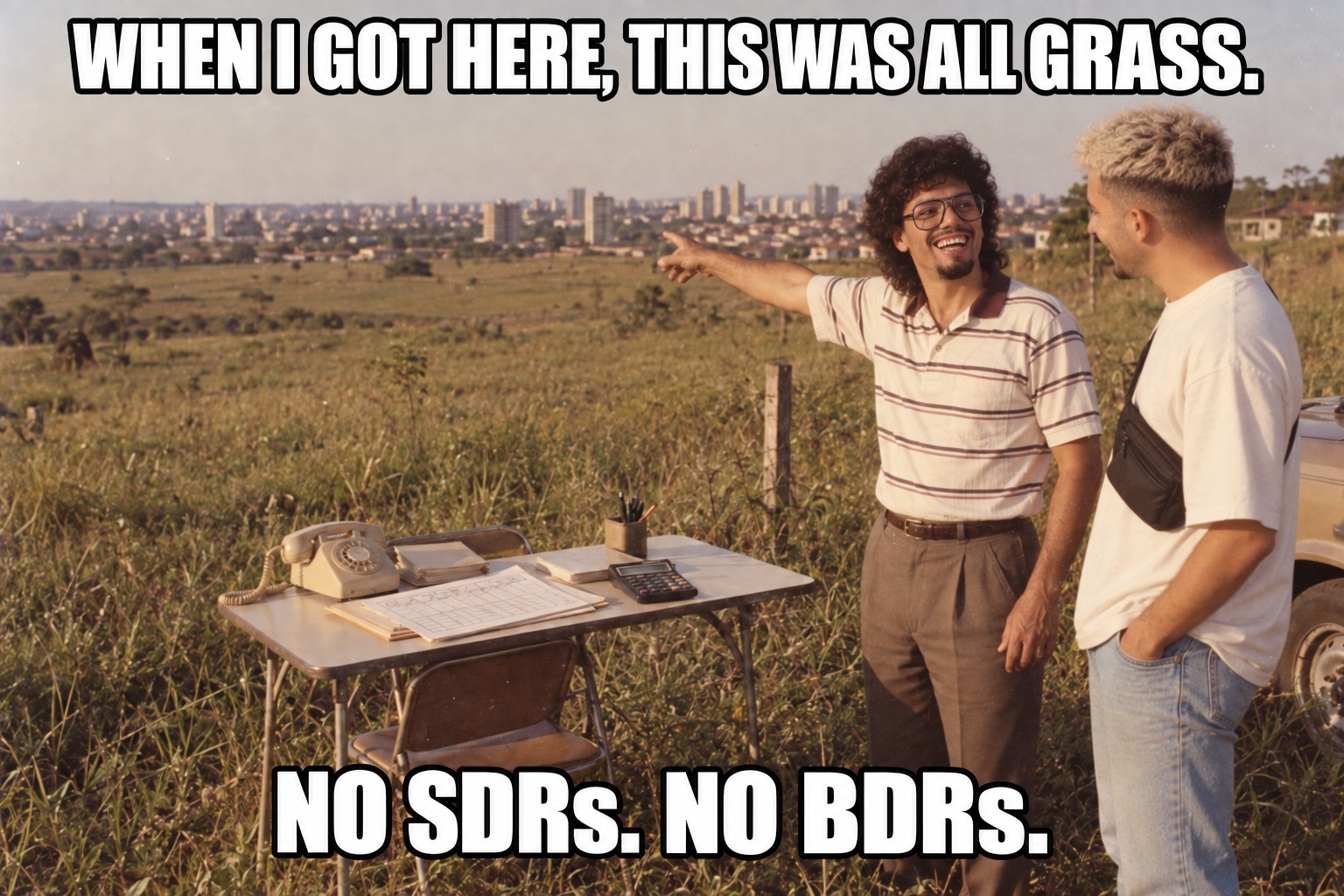
That is when the narrative started to drift.
Why does growth create narrative drift?
Because growth increases the number of people making choices from the company story while reducing their access to its original context.
The story now has to travel through multiple points of view:
- Sales needs language for a live conversation.
- Marketing needs language that travels across channels.
- Product needs criteria for what to build.
- New employees need to understand the company quickly.
- Customers bring their own words, needs, and expectations.
These groups rarely disagree by default. Most of the time, they are solving different problems with the part of the story available to them.
A founder can hold contradictions together through memory. They remember why one customer was a bad fit, why a feature was not built, why a word matters, and what the company was reacting against when it made its first choices.
A new employee receives the familiar phrases without those ten years of context. The words survive. Their value for making decisions becomes weaker.
The risk grows again when the company enters a new market, launches another product, or adds a new management layer. Each step creates one more translation of the original story. The first translation may be close. The fifth can still sound right while pointing somewhere else.
That is the uncomfortable part: growth does not create narrative drift because people stopped caring. It often creates drift because more people care, contribute, sell, build, and explain. The story gains reach faster than it gains a system.
How does narrative drift happen?
It happens like a telephone game, except every person in the game has a target to hit.
Marketing hears the founder explain the company and turns it into a campaign. Sales adapts the campaign to survive a real call. Product listens to what Sales is winning and turns part of that into a roadmap. Customer Success inherits the customer who bought that version of the promise. Then the founder hears the company described six months later and says, “That is not what I meant.”
No one necessarily lied. Each person made a reasonable adjustment from where they were standing.
Imagine the founder says, “We help teams make better commercial decisions.” Marketing shortens it to “grow revenue with data.” Sales discovers that “more qualified leads” closes faster. Product prioritizes lead scoring. Customers begin to understand the company as a scoring tool. All the sentences are connected, but the meaning has narrowed at every handoff.
The opposite can happen too. Teams add so many promises that the company becomes impossible to recognize. One deck sells efficiency, another transformation, another AI, and another a category nobody inside the company uses in a real conversation.
The drift becomes visible when Marketing describes one problem while Sales wins deals around another, or customers value an outcome that barely appears on the website. Employees may know the tagline and still need the founder to explain what it means in practice.
What is narrative drift?
Narrative drift is the growing distance between the story a company intends to tell and the stories its people, customers, products, and decisions actually express.
It is not simply inconsistent copy. A homepage and a sales deck can use the same words while the people behind them make completely different decisions. The real question is not “Are we repeating the message?” It is “Does this message still lead us toward the same company?”
Drift can begin after healthy changes such as international expansion, a new product, an acquisition, or rapid hiring. The official story simply moves more slowly than the business.
Some drift is useful. Customers may find value the company did not know how to name. Sales may discover a more urgent problem. Product may make the old promise obsolete. A narrative should learn from those signals.
The problem is unmanaged drift. When nobody examines the new versions or decides what belongs, the loudest campaign, the biggest deal, or the newest executive can quietly become the company strategy.
What are the signs that your company has outgrown its story?
You usually feel it before you can prove it. A piece of content sounds correct, but it does not sound like the company. A new hire repeats the message, but applies it to the wrong customer. A meeting about one campaign becomes another argument about what the business actually does.
The clearest signs appear when different groups need the founder to reconcile their explanations.
- The founder keeps correcting how the company is explained. A pitch, post, product page, or interview comes back with technically accurate words and the wrong meaning. Or, even worse, the team starts copying competitors to generate volume and vanity KPIs, using another bullshit hook because someone needs to “stop the scroll.” The content may perform, but it could belong to anyone.
- Sales, Marketing, and Product organize the problem differently. Each team names a different cause, enemy, priority, or desired change. You see the scale of it in the constant disagreement about what is qualified. Marketing generates leads. Sales says the leads are shit, but closes one anyway. Customer Success says it was a bad customer, and that is why they churned. The argument looks operational, but underneath it is a story problem: the teams do not share the same definition of who this is for and why they should buy.
- New employees learn phrases without learning how to decide from them. They can repeat the mission and still cannot tell which opportunity fits the company's direction. Every unusual choice has to travel back to someone who “knows what the founder meant.”
- Customers describe value the company does not use. The strongest customer language stays in calls, support conversations, and private messages while the public story relies on internal vocabulary. Sometimes the customer version is clearer than the official one. Sometimes it points to a promise the company never decided to make. Both are worth investigating.
- The business changed its promise without changing its story. A new product, market, buyer, or stage altered what customers can expect, but the company still introduces itself through an earlier version. The old story is not false. It is just too small for the decisions the business now has to make.
One sign can be local. Several signs appearing together usually justify a narrative audit.
How is a strategic narrative different from a rebrand?
Think of the strategic narrative as the meaning people need to carry. A rebrand is how the company makes that meaning recognizable.
A strategic narrative explains what changed, why it matters, what the company believes, and how that belief should guide action. A rebrand gives the company a consistent expression through identity, language, and design.
The two can support each other, but they do not solve the same problem.
| A strategic narrative helps people | A rebrand helps people |
|---|---|
| explain the change in the market | recognize the company |
| connect the company's past and next chapter | see and hear a consistent expression |
| choose which problems and customers fit | identify approved visual and verbal assets |
| make compatible decisions across teams | apply the identity across touchpoints |
You can rebrand a drifting company and make every disconnected version look consistent. Beautiful, but still disconnected. You can also build a strong strategic narrative and fail to give people a practical way to express it. The best work connects both.
I saw that relationship inside Exact Sales. At the end of 2016, as I remember it, a branding consultancy presented the company's new identity to employees through a comparison with Moneyball. The reference made the company's move from instinct toward data easier to see. It connected a familiar story to the questions, scores, roles, and commercial process we already used.
The part that stayed with me was not a color or a logo. It was the room understanding its own role. Everyone knew the part they played.
The Moneyball comparison is my memory from inside the company. Theo's public accounts confirm the spreadsheet, the scoring logic, the fast growth, and the spread of pre-sales. They do not mention that presentation or the comparison. Keeping those sources separate matters because a useful company narrative needs evidence people can inspect.
Can narrative decisions be guided by data?
Yes, but not by pretending narrative is a spreadsheet with one objectively correct answer.
Customer calls, sales notes, lost deals, product decisions, support conversations, founder stories, and employee interviews all show which explanations already shape action. They let you see which language is repeated, where expectations separate, and which story survives outside the leadership room.
Data adds discipline to interpretation. A customer phrase repeated across ten interviews deserves different weight from a phrase created during one internal workshop. A story employees use to make a difficult choice has a different function from a line they only recognize on a slide.
But frequency is not the same as direction. The phrase people repeat most may describe the company you are leaving, not the one you are trying to build. A large customer can create a lot of evidence and still pull the company somewhere it does not want to go.
Intuition still has a role. Founders often sense a change before the evidence can explain it. The work is to capture that intuition, compare it with what other people see, and choose a direction the company can defend.
That is why the Moneyball memory came back to me years later. I remembered the comparison before I remembered every detail around it. It gave me a structure for something I was now seeing in narrative work: instinct can start the inquiry, and evidence can help a company turn that instinct into shared criteria.
How does a narrative audit realign a growing company?
The audit puts the competing versions of the company in the same room. It shows where they agree, where they split, and which differences are already changing decisions.
The goal is not to vote for the most popular story. It is to understand what the business has become and choose the meaning it wants people to carry forward.
1. Collect the stories people already use
Start by listening, not editing. Interview the founder, customer-facing teams, Product, and a useful range of customers. Gather literal phrases, repeated examples, objections, stories, and explanations that changed a decision.
Do not ask only, “What is our message?” Ask what people say on a difficult sales call, how they decide a customer is a bad fit, which promise Product refuses to make, and what a customer tells a colleague after the company leaves the room.
2. Find the differences that change behavior
Not every difference is a problem. Sales and Product do not need identical scripts. Different word choices can coexist.
Look for the gaps that send people in incompatible directions: different definitions of the customer, the problem, the market change, the desired future, or the company's role in making that future possible.
3. Choose the direction the company can defend
Connect the company's evidence, belief, and ambition. A strategic narrative explains the market change, names the tension customers feel, and gives the company a credible role in what happens next.
This is where the company has to choose. A narrative that includes every interpretation may avoid conflict, but it cannot guide anyone.
4. Turn the narrative into a working system
Translate the direction into language, roles, criteria, and examples. Sales needs to recognize a fitting conversation. Marketing needs to know which stories reinforce the direction. Product needs to understand which choices make the promise credible. Leaders need to know what the narrative asks them to say no to.
A deck can document the story. A system helps people use it.
5. Test whether the story works without the founder
Watch what people do when the original source is absent. Ask teams to explain the company and apply the narrative to a real decision: a prospect, a campaign, a product request, or a new hire.
The test is not identical wording. It is coherent judgment. People should be able to adapt the story to their context without turning it into another company.
When should a founder run a narrative audit?
The useful moment is when competing explanations start costing the company something: slower decisions, confused customers, bad-fit deals, generic content, or a founder who has become the human approval system for every sentence.
It often follows a critical event: a new market, a major product change, a new leadership layer, an acquisition, international expansion, a category shift, a rebrand discussion, or a period of rapid hiring.
Sometimes the signal is quieter. The founder reviews a pitch that is completely accurate and somehow belongs to another company. Nobody can point to one wrong sentence. The meaning just disappeared between the sentences.
Run the audit before the team rewrites every page or commissions a new identity. Otherwise, you may spend a lot of money making the current confusion more consistent.
An audit shows which parts of the story survived, which parts changed, and which parts only looked aligned because the founder was still in the room.
What should happen after the audit?
The company should leave with more than a new message. It should have a narrative system people can use across decisions, conversations, and content.
At No More Gap, we build that system from the founder's experience, customer evidence, team interpretations, and the tensions between them. Then we choose a direction and translate it into a story that can travel.
That means people can find the source behind the message, understand the choices the company made, and adapt the narrative without inventing it again every time.
Narrative OS helps keep that work alive after the project. It gives founders and teams a place to retrieve the source material, create from approved evidence, and protect the decisions behind the story as the company keeps changing.
The founder still shapes the narrative. More people can carry it without waiting for the founder to join every room.
Frequently asked questions
What is narrative drift in a growing company?
It is the distance between the story a company intends to tell and the different stories expressed by its teams, customers, products, and decisions. It often appears when growth adds more voices but the original context still lives mainly with the founder.
How is a strategic narrative different from a rebrand?
A strategic narrative aligns the meaning and direction people use to make decisions. A rebrand shapes how that meaning becomes recognizable through language, identity, and design. They can work together, but a new identity alone will not reconcile competing versions of the company.
When should a founder run a narrative audit?
Run one when different explanations begin creating conflicting choices across Sales, Marketing, Product, employees, or customers. New markets, products, leadership layers, acquisitions, and rapid hiring are common moments to do it.
How can Sales and Marketing use the same company narrative?
They do not need to use identical sentences. They need to share the same view of the market change, customer tension, company belief, and desired direction. Sales can adapt it to a live conversation and Marketing to a channel without changing what the company means.
Can narrative decisions be guided by data?
Yes. Customer language, sales conversations, product choices, employee stories, and behavioral signals give the company evidence to test intuition and understand where stories diverge. The evidence informs the choice; it does not make the strategic choice on the company's behalf.
See where your company story is drifting
The Narrative Drift Check helps you compare the versions of your company currently carried by the founder, teams, customers, and public story.
Take the Narrative Drift Check
If the answers reveal several versions of the same company, No More Gap can help you turn them into a Narrative System your people can use.
Source note
The Exact Sales story combines Vini's account as employee 19 with Theo Orosco's public account of the company's early years and Exact Sales' history of pre-sales. The Moneyball presentation and the description of the early team come from Vini's memory. The spreadsheet, scoring mechanism, fast growth, and spread of the pre-sales category are also documented in those public sources.